
Controlling For Party Affiliation
How the new Callais factors solve the puzzle of disentangling race and politics

Yesterday the Supreme Court released its decision in Callais, the Louisiana redistricting case in which the Court determined that Section 2 of the Voting Rights Act is constitutional, if properly understood as not exceeding the “race neutral” bounds of the Constitution.
In achieving this objective, the Court revised the requirements for identifying and remedying racial vote dilution that have been used for 40 years, known as the Gingles factors, a three prong test that required plaintiffs to demonstrate that 1) a reasonably configured district can be drawn that allows protected classes to have equal opportunity to elect candidates of choice, 2) the protected group indeed votes as a cohesive bloc, and that 3) the white majority also votes as a cohesive block, preventing racial minorities from electing their preferred candidates.
The new test just adds an adjustment:
To satisfy the second and third preconditions—politically cohesive voting by the minority and racial-bloc voting by the majority—the plaintiffs must provide an analysis that controls for party affiliation. In other words, they must show that voters engage in racial bloc voting that cannot be explained by partisan affiliation. This is, once again, critical for “disentangl[ing] race and politics.” Alexander, 602 U. S., at 6. (p.30)
The Court arrives at this new requirement by way of Rucho, a 2018 partisan gerrymandering case in which the Court determined that the ability to dilute the weight of a rival party’s vote shares is a compelling state interest for whichever party controls the redistricting process. In Callais, the Court follows up on this logic to determine that “courts must treat partisan advantage like any other race-neutral aim: a constitutionally permissible criterion that States may rely on as desired (p.25, my italics).
So how does one go about treating partisan affiliation as race-neutral? In statistics, “controlling” for an additional factor is typically interpreted as requiring a test that partitions the variance (range of values) in a dependent variable, so that you can distinguish the unique or independent effect of one factor on that variable, compared to other “control” variables. In this case, we might set up a test to measure whether vote dilution, or wasted votes (votes for losing candidates or surplus votes for winning candidates) is higher for white or black voters, after controlling for partisan vote dilution, or the amount of vote dilution that results from partisan affiliation.
Here is what this might look like for the Louisiana Congressional districts, the districting plan considered under Callais. I took the original plan adopted after the 2020 Census, which contained only one majority-black district and was clearly a discriminatory plan under the old Gingles factors, and 1) estimated the level of racial polarization in voting to determine how black and white voters differ in party support, then 2) estimated the ratio of black-to-white wasted votes within-party so as to control for party affiliation. So I am testing whether black or white voters have their voting power reduced as a result of which districts they vote in, regardless of which party they support.
The results are revealing: when we tally up the wasted votes across the districts, the partisan advantage is stark, with more than three-quarters of votes (across 2020-2023 congressional, presidential, and statewide offices) were wasted for those supporting the Democratic Party in the Republican-controlled state. However, we don’t find that black Democratic voters suffer more than white Democrats, in fact, that one majority-black seat pays off, giving black Democrats a slight advantage in vote dilution compared to their white counterparts. Moreover, my analysis reveals that it is black Republicans who face worse discrimination, as 45% of their votes are wasted on average, compared to just 33% for white Republicans!

However, because the statewide share of the black Republican vote is little more than a rounding error (3%-12% of black voters support Republicans), this results in only about 3% total vote dilution not accounted for by the race-neutral impact of partisan affiliation. Barely any detectable racial vote dilution.
Some will say hold on, if we look only at race, regardless of partisanship, we see very different results. Measuring simply the value of a vote cast, or whether it results in representation, shows a remarkable disparity:
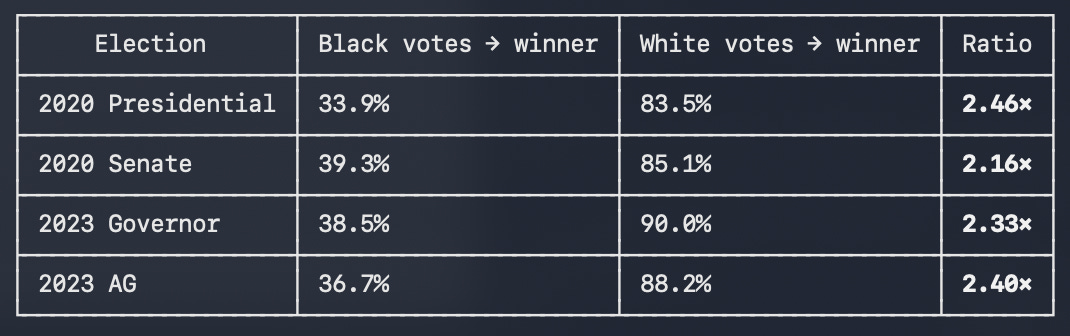
The value of a white vote in Louisiana is roughly 2.3 times that of a black vote cast in the same state under the original districting plan. This happens as a result of most white voters supporting the Republican Party, who engineered themselves 5 of 6 Congressional seats, while fully 90% of black voters who support the Democratic Party, and make up about a third of the electorate, have a single seat. The 2020 Presidential ratio is highest (2.46) because black Democratic support is at its most extreme (97.8%) but winning only one seat, few black votes result in representation.
However, this sort of analysis reflects the old, outdated, Gingles way of thinking. Through Callais, the Court encourages us not to confuse partisanship with race, and to accept that politics is fundamentally about partisan affiliation. Once we have disentangled race from partisan affiliation, we can better understand the Court’s reluctance to entangle themselves into what are, at heart, matters of partisan politics.
Indeed, the Court’s vision brings clarity to much of the convoluted thinking that has confused partisanship with race over our history. Consider the 1920 Ocoee Massacre, when Republican Mose Norman was turned away from the polls on Election Day. When he and other Republicans protested, Democratic poll workers and other government officials responded in what would become the largest incident of voting-day violence in United States history.
Remember when, as part of the partisan effort to install Democrat Wade Hampton III as governor of South Carolina, Democratic paramilitary forces murdered Republican officeholders governing the town of Hamburg, South Carolina, in 1876?
And who can forget the Wilmington Insurrection of 1898 in North Carolina? After a bipartisan fusion coalition of Republicans and Populists won local elections in Wilmington—then North Carolina’s largest city—Democrats organized a violent overthrow. On November 10, 1898, an armed mob led by Democrat Alfred Moore Waddell forced the elected mayor, aldermen, and police chief to resign at gunpoint, installed themselves in office, and murdered from 60 to 300 Republicans and Populists in the process.
And of course there was the insurrection aimed at overthrowing the Republican government of Louisiana in 1874, when 5,000 Democratic activists seized control of the statehouse until federal troops eventually restored control by the Republican Party. A year earlier in Grant Parish, Louisiana, Democrats contested the gubernatorial election by killing up to 150 Republicans who had occupied the courthouse to defend the elected Republican government.
I hope you see the point, that you can’t separate politics from race. The Supreme Court has clarified a vision of US politics in which partisan affiliation serves as an antiseptic to the politics of race. But let’s be clear, it is a vision in which the rights of all voters are subordinate to supposedly “race-neutral” claims of partisan advantage. For me personally, the Court’s decision in Callais provides clarification on where we are now as a country across a spectrum of two competing visions: the US as a democratic republic with racial tensions, and the US as a racial political order that is frustratingly, intermittently, and I hope expansively, democratic.