
The Anti-Party Trap
People Without Parties Have No Power

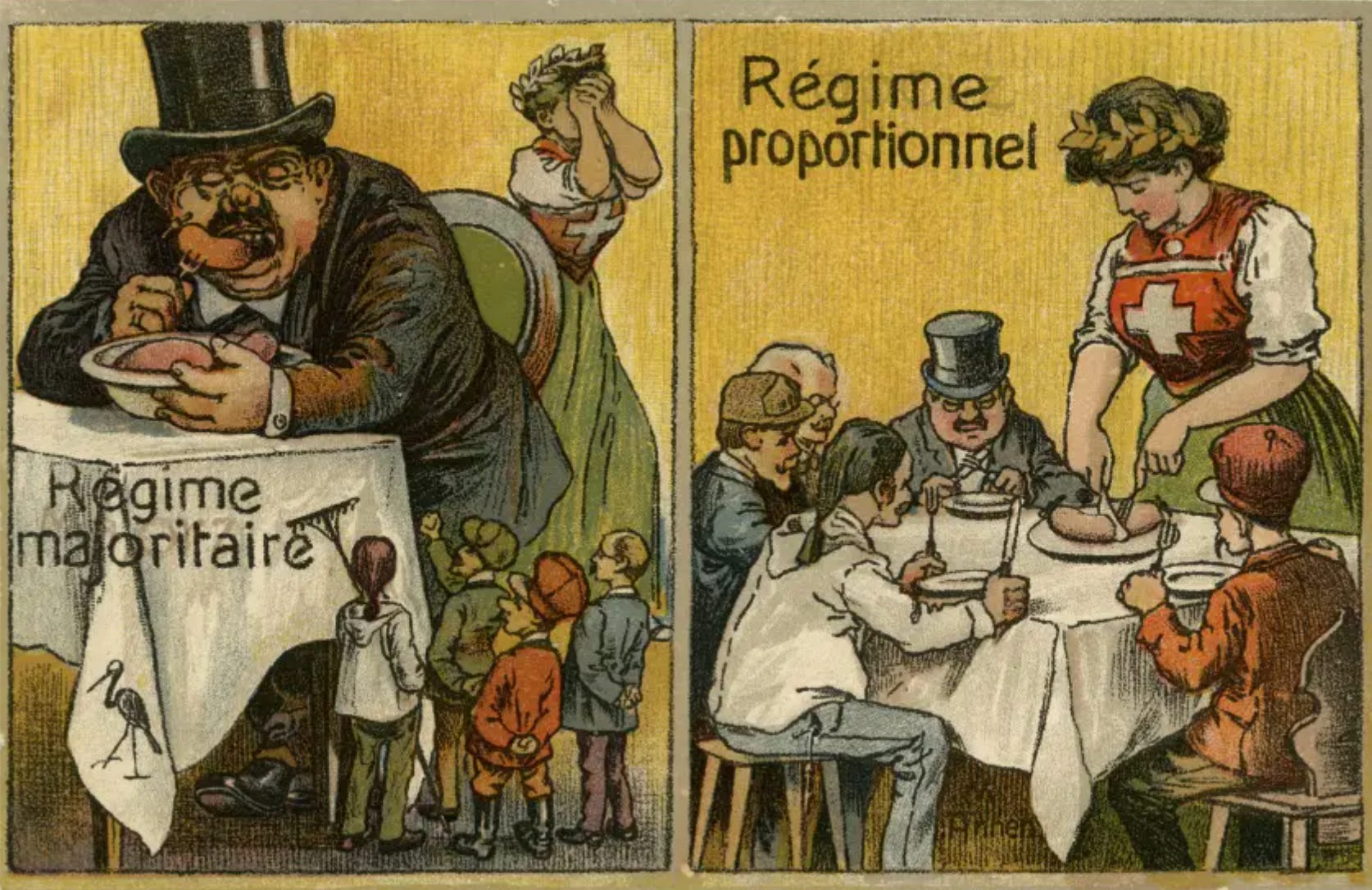
Caption: The proportional election system was one of the most pressing topics in Switzerland at the turn of the 19th and 20th centuries. Here, a 1918 postcard depicts a campaign poster in favor of the transition to a proportional electoral system. Credit: Schweizerisches Sozialarchiv
Open primaries advocate John Opdycke recently attacked Lee Drutman and Drutman named the move for what it is: an ad hominem dressed up as a defense of “folksiness.” But the deeper problem, which Lee does not name, probably because he is too nice a guy, is that Opdycke’s “populism” is pointed in exactly the wrong direction. His is not a merited critique of technocratic reform; it is an ideological attack on the one institution most capable of giving ordinary people durable power, and it arrives wrapped in the language of giving power back to them.
Opdycke’s pitch is that the parties are the problem—”power hungry party hacks” and “division hustlers” standing between the people and self-government—and that the solution is to route them. This is, to be honest, a brilliant political strategy. It taps into a genuine and widespread disgust with both parties and offers a satisfying villain. But we should be honest about who finds this framing most congenial. The open-primaries and “nonpartisan reform” infrastructure is substantially bankrolled by Unite America and a handful of wealthy, center-right funders, whose explicit program is “open” or non-partisan primaries and intervening in primaries against candidates they deem too “partisan” (read: not center-right). It is no coincidence that the very wealthy are drawn to weakening parties. This is the electoral reform equivalent of DOGE: clear out the bureaucracy, get the obstructive intermediaries out of the way, and trust that good outcomes follow. This begs the question—once you’ve cleared the field, who is politics actually going to work for?
The answer is not “the folks.” It’s whoever is already organized and resource-rich enough not to need a party. And that is precisely the point the political science cuts against. As Protect Democracy’s volume on political parties argues, parties are the structural basis of democracy—”unthinkable save in terms of the parties,” is Schattschneider’s old line. They are the thing that lets people who individually have less—less money, less media access, fewer connections—aggregate their numbers into power that can win seats and set policy. Strip out the party as the organizing vehicle, and you don’t get a purer, more direct democracy. You get politics by other heuristics: charisma, celebrity, and cash. The same volume documents the historical record bluntly: institutional efforts to thwart parties have a two-century track record of failure, and the “party-weakened alternatives that emerge are often worse than what existed before”—frequently empowering wealthy interests and reducing the accountability of elected officials.
Parties matter not just for winning but for translating mass mobilization into policy. The companion research on social movements and parties shows that movements achieve durable change largely by anchoring themselves to and reshaping parties from the inside—the Tea Party within the GOP, the Christian right, the civil rights coalition’s realignment of the Democrats. Parties are the transmission belt between movements in the streets and laws on the books. Electoral reform that dissolves that belt in the name of empowerment leaves movements with no machinery to channel their energy.
This is why the open-primary “movement” is better understood as pseudo-populism. Its rhetoric is anti-elite; its structural effect is to remove the primary mechanism through which masses organize. Take away the party as the structure of democratic decision-making and ask, again, who is left standing? Those who never needed political organization to get what they wanted from government in the first place.
And here is the irony Opdycke should sit with, given that he reaches for the Progressive era as a model. His own lineage runs through the very reformers he presumably disclaims, as the progressive movement was also elite-driven. The Progressive-era assault on party “machines” was sold in exactly his terms—clean out the corrupt bosses so government could be honest and efficient—and it was substantially a project of white middle-class businessmen who wanted city government restructured to run on businesslike lines with parties given as little influence as possible: reforms marketed as democratization that in practice shifted power toward upper-income and business groups. “Get the machines out of the way” was the populist slogan; consolidating elite control was the result. Drutman, by contrast, is actually trying to repair the party system rather than dismantle it. Opdycke has the genealogy exactly inverted.
None of this means our parties are healthy—they are not, and Drutman’s own work is a sustained argument that they’re badly broken in part due to our electoral system. We all recognize the need for structural reform. But the reformer’s motto should be Hippocratic: first, do no harm. A patient with a failing circulatory system is not improved by removing the heart. Our party system is the circulatory system of democratic power for people who have no other means of exercising it. The task is to heal the party system—to make parties more representative and more accountable—not to bleed them further in the name of the people and to the benefit of the already advantaged.
When two parties have a duopoly and control the entire system, funded by the agendas of their biggest donors - to what can independents do no harm? Not to mention that Washington warned us of this in his farewell address.